

MIKROE-4800

Mikroe
932-MIKROE-4800
MIKROE-4800

Herst.:

Beschreibung:
IC-Entwicklungstools für Verstärker GainAMP 3 Click

Auf Lager: 4

Lagerbestand:
4 sofort lieferbar
Lieferzeit ab Hersteller:
6 Wochen Geschätzte Produktionszeit des Werks für Mengen, die größer als angezeigt sind.
Minimum: 1   Vielfache: 1
Stückpreis:
CHF -.--
Erw. Preis:
CHF -.--
Vorauss. Zolltarif:

Preis (CHF)

Menge Stückpreis
Erw. Preis
CHF 24.79 CHF 24.79

Produktattribut Attributwert Attribut auswählen
Mikroe
Produktkategorie: IC-Entwicklungstools für Verstärker
RoHS:  
Add-On Boards
Variable Gain Amplifiers
ADA4254
3.3 V, 5 V
Marke: Mikroe
Abmessungen: 57.15 mm x 25.4 mm
Zum Gebrauch mit: Industrial Systems, Process Control
Schnittstellen-Typ: SPI
Maximale Betriebstemperatur: + 125 C
Minimale Betriebstemperatur: - 40 C
Produkt-Typ: Amplifier IC Development Tools
Verpackung ab Werk: 1
Unterkategorie: Development Tools
Produkte gefunden:
Um ähnliche Produkte anzuzeigen, wählen Sie mindestens ein Kontrollkästchen aus
Um ähnliche Produkte in dieser Kategorie anzuzeigen, wählen Sie mindestens ein Kontrollkästchen oben aus.
Ausgewählte Attribute: 0

CNHTS:
8543709990
USHTS:
8543709810
ECCN:
EAR99

Audio & Voice Click Boards

Mikroe Audio and Voice Click Boards are used to add audio and video for applications and designs. Mikroe Click Boards are based around the mikroBUS™ interface standard and easily add incredible capabilities to systems. The devices include MP3, FM, and text-to-speech to name a few.

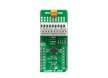
GainAMP 3 Click

Mikroe GainAMP 3 Click features the Analog Devices ADA4254 zero drift, high voltage, programmable gain instrumentation amplifier. It features 12 binary weighted gains and three scaling gain options resulting in 36 possible gain settings. It comes with an input multiplexer providing ±60V protection to the high impedance inputs of the amplifier. The GainAMP 3 has an excitation current source output available to bias sensors like resistance temperature detectors (RTDs). The ADA4254 zero-drift amplifier topology self-calibrates DC errors and low-frequency noise. This achieves excellent DC precision over the entire specified temperature range, maximizing dynamic range, and significantly reducing calibration requirements in many applications.