




CML Micro CMX992 RF Quadrature/Low IF Receiver
CML Micro CMX992 RF Quadrature/Low IF Receiver is a single-chip, high-performance RF receiver IC for analog and digital radio systems. It operates from 100MHz to 1GHz and features an I/Q architecture that supports multiple modulation types and bandwidths with a single radio design. The CMX992 offers user-selected modes suited to different application requirements. CMX992 is for use in applications with highly linear modulations, including TETRA, where a typical transmitter solution would include a Cartesian Feedback Transmitter. Available in a 48-pin VQFN package, the device operates from a single 3.3V supply within a -40°C to +85°C temperature range.
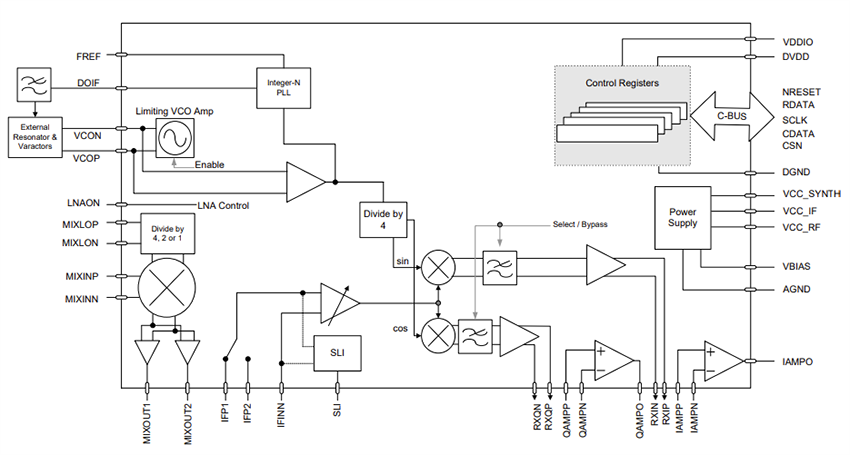
The Rx path includes an integrated 1st Rx mixer having two outputs to support two external 1st IF filter choices, then an integrated 2:1 input mux followed by VGA and wideband signal level measurement functions to support AGC implementation.
The 1st IF signal is then either I/Q demodulated to zero IF or mixed to a low IF output.
Features
- High performance (100MHz to 1GHz) RF receiver
- Rx
- RF mixer with output select
- 1st IF input select
- 1st IF Variable Gain Amplifier (VGA)
- 1st IF Signal Level Indicator (SLI)
- Two-mode demodulator
- I/Q zero IF with differential outputs
- 2x selectable IF outputs (450kHz or 455kHz)
- IF
- IF LO synthesizer
- IF VCO negative-resistance amplifier
- 3.0V to 3.6V operating supply range
- 11.5dB to 13dB typical noise figure range
- -40°C to +85°C operating temperature range
Applications
- Analog, digital, and multi-mode radio
- Software Defined Radio (SDR)
- Portable, mobile, and base station terminals
- TETRA and APCO P25: Phase 1 and Phase 2 TDMA
- Automatic Identification System (AIS) transponders
- Constant envelope and linear modulation
- Compatible with CMX998
- 25kHz, 12.5kHz, and 6.25kHz narrowband systems
- EN 302 561 wideband systems
- APCO Project 25: TIA-102.CAAB, ETSI: EN 300 113, EN 301 166, EN 300 220, TS 102 361 (DMR)
- Satellite communications
Videos
Block Diagram
Related Products

CML Micro Receivers (RX)
Flexible receiver ICs ideal for HF/VHF/UHF radios, wireless data terminals, and more.
Veröffentlichungsdatum: 2019-11-19
| Aktualisiert: 2023-08-01