




Parker Chomerics CHO-THERM® 1674 1.0W/m-K Conductive Insulator Pads

Parker Chomerics CHO-THERM® 1674 Conductive Insulator Pads feature 1.0W/m·K thermal conductivity, 2.5kV voltage breakdown, 0.41°C-in2/W (2.6°C-cm2/W) thermal impedance. These commercial-grade, silicone and fiberglass thermal pads offer robust mechanical strength and operate in a wide temperature range of -40°C to +200°C. The CHO-THERM 1674 series is offered as dry pads with an optional pressure-sensitive adhesive (PSA) acrylic layer for ease of installation. The pads provide an alternative to greased mica insulators between discrete power devices and heat sinks. Parker Chomerics CHO-THERM 1674 Conductive Insulator Pads come in a standard thickness of 0.010" (0.25mm) with a thickness tolerance of ±0.001" (±0.025mm).
Features
- Blue color
- Silicone material
- Fiberglass-reinforcement carrier
- Robust mechanical strength
- Excellent mechanical strength and puncture resistance
- Available with or without acrylic PSA
- Good thermal properties
- Available on continuous rolls for easy peel-and-stick application
- Wide operating range
- UL recognized V-0 flammability rating
- RoHS compliant
Applications
- Power conversion equipment
- Power supplies and UPS
- Power semiconductors
- Automotive electronics
- Motor and engine controllers
- Televisions and consumer electronics
Specifications
- 0.010" (0.25mm) standard thickness
- ±0.001" (±0.025mm) thickness tolerance
- -40°C to +200°C operating temperature range
- 0.41°C-in2/W (2.6°C-cm2/W) thermal impedance at 300psi (tested without PSA)
- 1.0W/m·K thermal conductivity
- 1.0J/g-K heat capacity
- 300ppm/K coefficient of thermal expansion
- 2500VAC voltage breakdown (dry)
- 1014Ω-cm volume resistivity (dry)
- 1500psi (10.3MPa) tensile strength
- 100lb/in (17.5kN/m) tear strength
- 2% elongation
- 85 Shore A hardness
- 2.45 specific gravity
Application Example

Related Insulator Pads
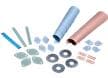
Parker Chomerics CHO-THERM® Thermally Conductive Insulator Pads
Offers alternative to greased mica insulators placed between discrete power devices and heat sinks.